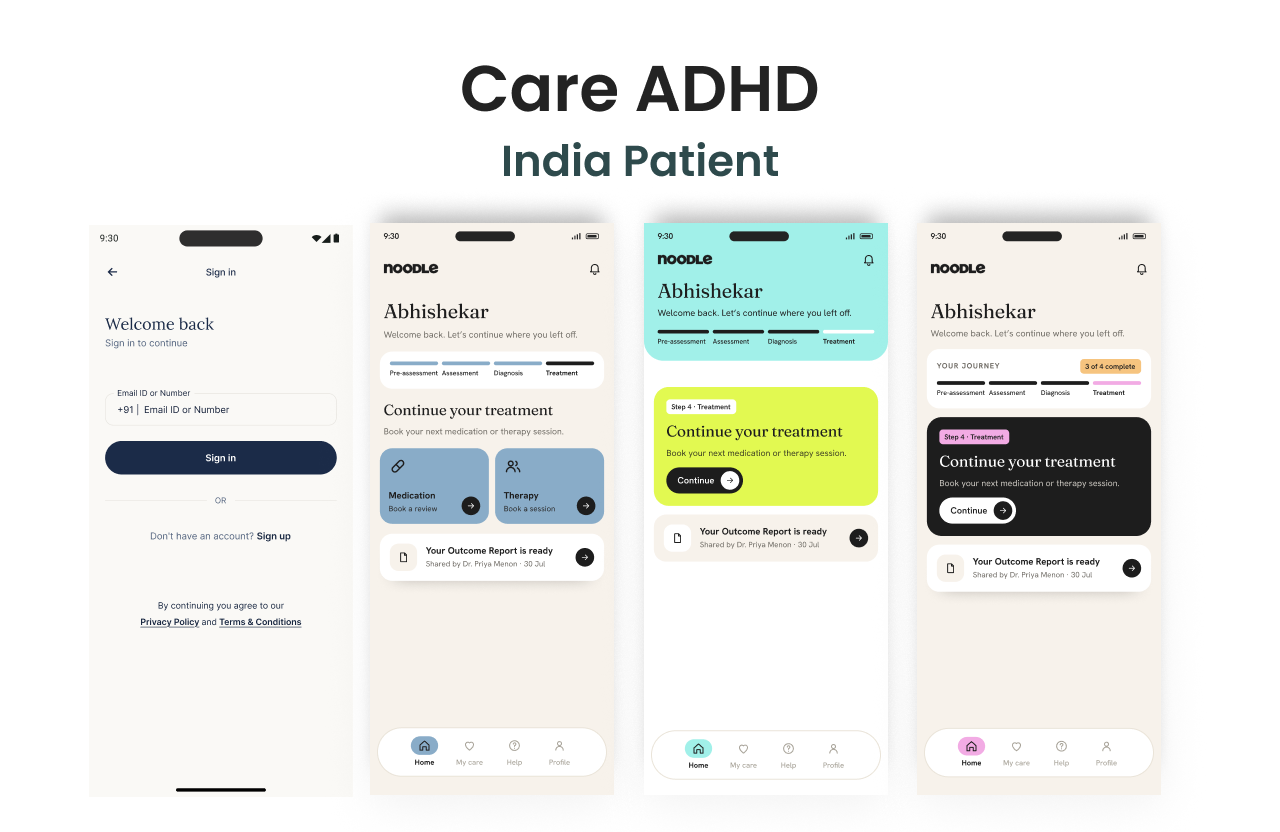
ADHD Patient Indian App: Care & Support for Adults
Accessible ADHD screening, professional assessment, personalized care plans & ongoing support for Indian adults 18+
Project:
ADHD Care & Support App for India
Target Users:
Adults 18+ in India with ADHD concerns
Deliverables:
Full UX Design, User Flows, Screens, Documentation
Tools:
Figma, User Journey Maps, Wireframes, Prototypes
Type:
Design Concept & Exploration
ADHD Patient Indian App is a proposed ADHD care and support app for adults in India. It helps people understand their ADHD symptoms, access qualified professionals for assessment, and follow a personalized care plan through simple, manageable steps.
The main idea: "Help me understand what to do next, without overwhelming me."
Status: Design concept and exploration. This case study documents the UX design, user journeys, key screens, and design thinking—not a functional or clinically-validated product.
Who is it for?
How does it work? - 5 Core Steps
1. Understand your concerns
Users answer a short ADHD screening questionnaire at their own pace. They can pause and return later. Results suggest next steps—not a diagnosis.
2. Find appropriate support
The app checks for safety concerns separately from ADHD symptoms. People without immediate concerns can continue to routine assessment. Those needing urgent help are directed to professional or emergency support. Severe ADHD symptoms alone do not mean someone is "high risk."
3. Connect with a professional
Users explore qualified clinicians, see appointment costs and language options, book consultations, and prepare for their assessment.
4. Follow a personalized care plan
After professional assessment, users access recommended therapy, practical support, and medication management when prescribed. The app supports care—it does not independently diagnose or prescribe.
5. Manage everyday challenges
Optional tools help users break tasks into smaller steps, plan focus sessions, remember appointments, and track concerns to discuss with their care team.
What makes the experience ADHD-friendly?
Instead of overwhelming users with everything at once, the app prioritizes:
Why is it relevant to India?
The design specifically addresses Indian contexts and challenges:
The Problem
Many Indian adults aged 18+ with ADHD face significant barriers to assessment, care, and support. They struggle with:
Design Goal: Create an accessible, ADHD-friendly mobile app that helps Indian adults move from understanding their concerns through professional assessment, personalized care planning, therapy, and ongoing support—without shame, pressure, or jargon.
Research Phase
Core User Journey - 12 Stages:
1. Welcome & Preferences - Let users choose their preferred language and accessibility settings. Explain what the app can and cannot do.
2. Choose Starting Point - "I think I may have ADHD," "I already have a diagnosis," or "I need help continuing my care."
3. Consent & Privacy - Explain how health information is used and shared. Make caregiver involvement optional and consent-based.
4. Initial Screening - Present a clinically appropriate adult ADHD screening questionnaire in small, manageable steps. Allow breaks and saved progress. Clearly state that screening is not a diagnosis.
5. Safety Check - Keep immediate safety concerns separate from ADHD symptom severity. Do not label someone "high risk" simply because their ADHD symptoms are severe.
6. Appropriate Next Steps - Based on safety assessment, offer professional assessment, education, and optional daily coping tools.
7. Professional Assessment - Explain the process, clinician credentials, appointment language, cost, duration, and preparation.
8. Personalized Care Plan - Present clinician-recommended treatment, therapy, and practical support as understandable next steps.
9. Therapy & Daily Support - Offer appointment booking, clinician-guided exercises, task breakdowns, focus sessions, and optional reminders.
10. Prescribed Medication Tracking - Track medications only when prescribed and supervised by appropriately qualified clinicians.
11. Follow-ups - Make it easy to record concerns, discuss side effects with the care team, review progress, and request help.
12. Ongoing Support - Continue access to coping tools, community, and escalation pathways.
Competitor Analysis
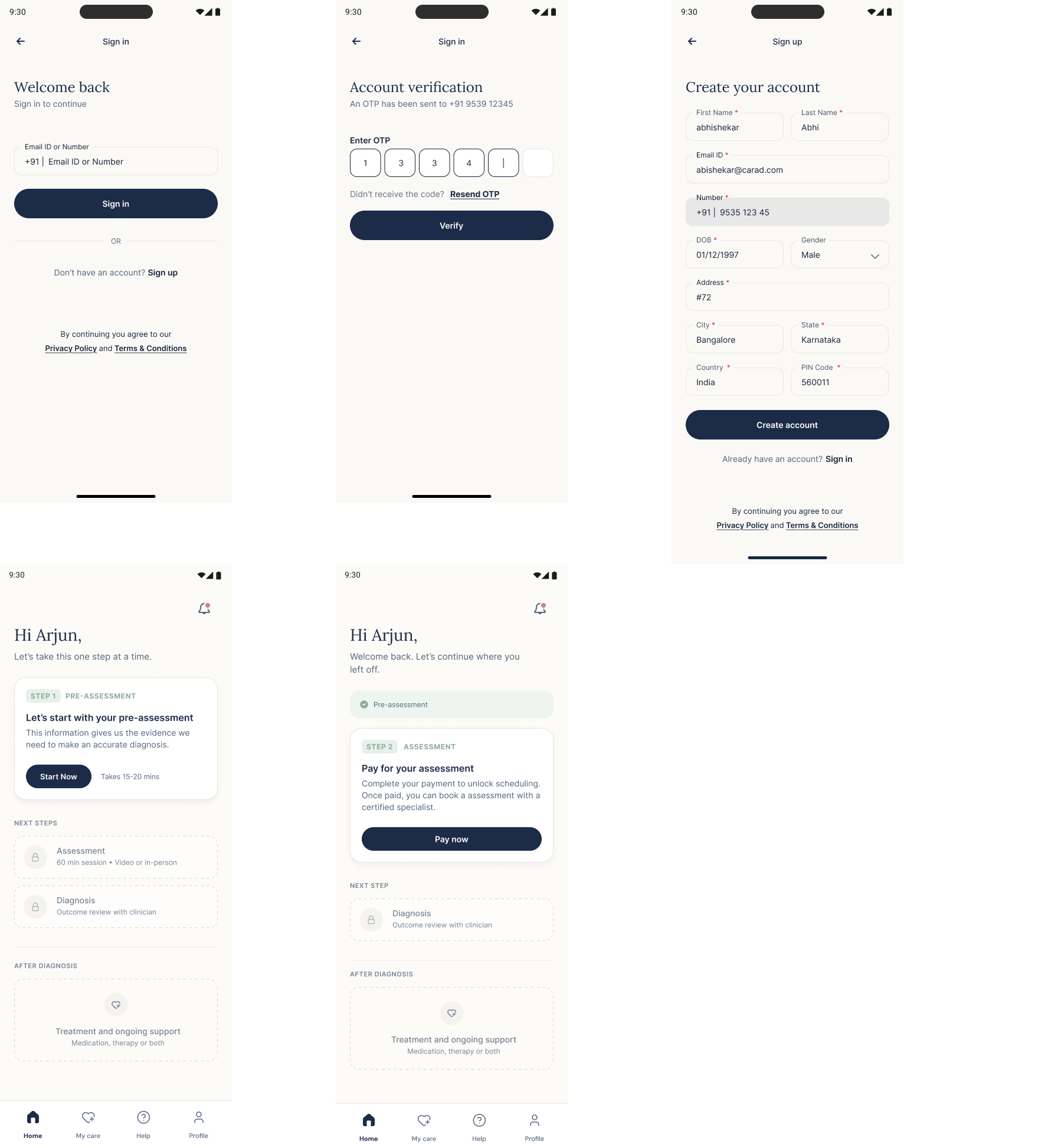
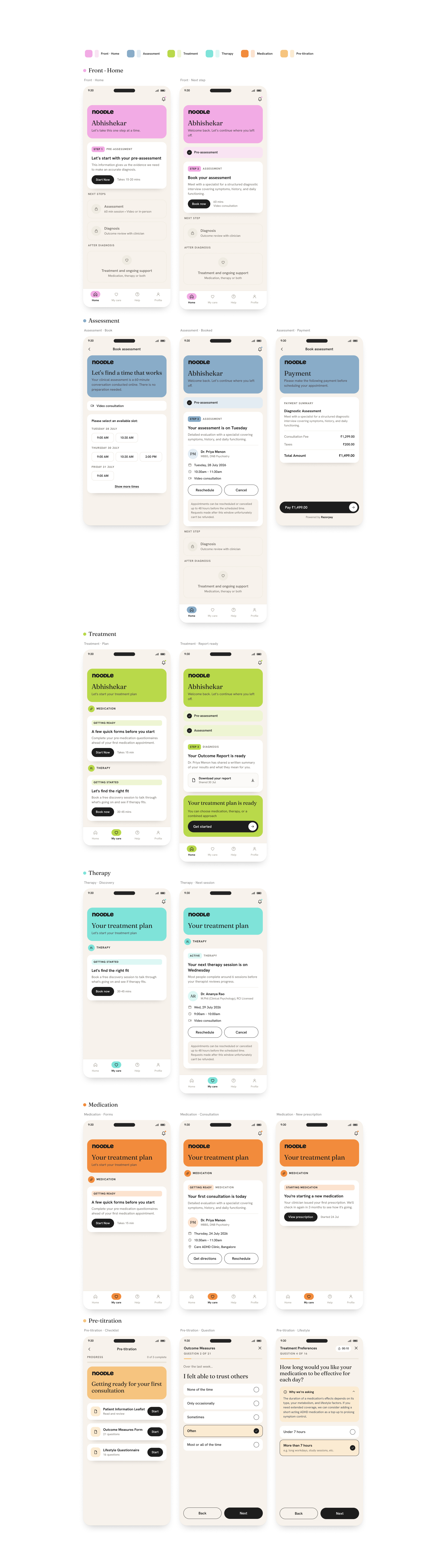
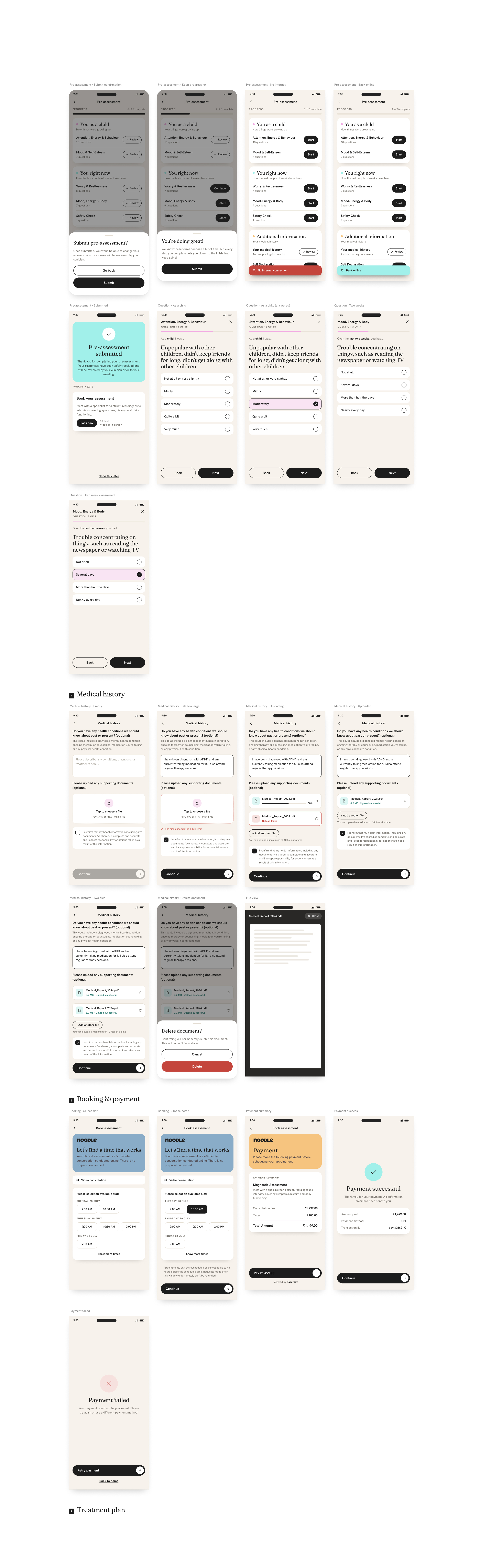
Key Screens Designed:
Two-Month Design Exploration Process
Design Approach: The design prioritizes ADHD-friendly principles at every stage:
Make every stage easy to understand - Show one primary action at a time, short instructions, clear progress, and an obvious next step.
Use warm, respectful language - Avoid shame, pressure, or exaggerated medical claims. Normalize ADHD as a neurodevelopmental variation, not a disorder.
Separate safety from severity - Keep immediate safety concerns distinct from ADHD symptom severity. A person with severe ADHD symptoms isn’t automatically “high risk.”
Indian context integration - Support English and selected Indian languages, show ₹ pricing with transparent fees, optimize for low-bandwidth use, and ensure discreet notification wording that respects privacy.
Accessibility throughout - Readable typography, generous spacing, strong contrast, large touch targets. Avoid crowded dashboards, distracting animation, and excessive notifications.
Design System & Visual Direction
Visual Direction - Calm & ADHD-Friendly:
Color Palette (Restrained):
Typography & Spacing:
Interaction Principles:
Overall Tone: Calm, friendly, respectful. Visual design reinforces that ADHD is a normal variation, not a defect. The interface should feel like a supportive companion, not a clinical tool.
Three Key Design Decisions & Trade-offs
Decision 1: Screening as Tool, Not Diagnosis
Challenge: Adults often self-diagnose via screening tools online, then feel validated or devastated without professional assessment. How do we use screening to educate without over-claiming?
Alternatives Explored: (1) Present screening results with percentile interpretation ("You score higher than 80% of users"), (2) Show results as "symptom intensity" without diagnostic language, (3) Results lead directly to professional assessment recommendation.
Decision Made: Screening results explain what symptoms suggest, but explicitly state "This is NOT a diagnosis. A qualified clinician must assess you." Position the screening as the beginning of the journey, not the destination.
Trade-off: Users may want definitive answers from the app. Gains: Prevents misdiagnosis, builds trust by being honest about limitations, sets healthy expectations for professional assessment.
Remaining Validation Needed: Clinical review by qualified Indian mental-health professionals. User testing to confirm messaging reduces self-diagnosis pressure.
Decision 2: Caregiver Involvement is Optional & Consent-Based
Challenge: In India, family dynamics around mental health are complex. Some users want family involvement; others need autonomy from family. How do we support both without judgment?
Alternatives Explored: (1) Family involvement mandatory, (2) Family involvement optional but default-recommended, (3) Users choose at each stage whether to involve caregivers.
Decision Made: Caregiver involvement is always optional. Users can proceed alone and add caregivers later if they choose. When adding caregivers, app makes clear what data each person sees.
Trade-off: Some users may miss supportive care opportunity. Gains: Respects autonomy, works for users with unsupportive families, makes app accessible to all users regardless of family context.
Remaining Validation Needed: Interviews with Indian adults about family dynamics and care preferences. Assessment of whether optional caregiver involvement affects treatment outcomes.
Decision 3: Immediate Safety vs. ADHD Severity
Challenge: Safety screening questionnaires often conflate "suicidal ideation" with "ADHD symptom severity." A person with severe ADHD may score "high risk" simply because inattention is severe. How do we separate these?
Alternatives Explored: (1) Combined safety & ADHD screening in one flow, (2) Separate screening but identical language (confusing), (3) Distinct screening phases with clear labels and different next-step pathways.
Decision Made: Safety screening is distinct and separate. Safety questions ask about immediate danger, self-harm, or crisis. ADHD screening focuses on attention, organization, and impulse control. Results show different pathways: safety concerns → immediate escalation; ADHD symptoms → professional assessment.
Trade-off: Longer onboarding journey. Gains: Prevents false escalation, appropriately triages urgent cases, de-stigmatizes ADHD severity as "not automatically a crisis."
Remaining Validation Needed: Clinical review by Indian mental-health professionals. User testing with ADHD adults to confirm messaging doesn't minimize real safety concerns.
Final Design Scope
Designed Screens & Flows:
Future Design Phases (Not Yet Completed):
Important Clinical & Legal Notes: This design represents UX and user-journey thinking. Implementation requires:
Lessons Learned
Language Matters in Mental Health Design: Words like "disorder," "defect," "risk," and "abnormal" carry shame. The same clinical information presented as "variation," "difference," and "trait" feels different to users. ADHD-friendly design is as much about de-stigmatization language as it is about interface simplicity.
Screening is Scary: Users coming to an ADHD app often have deep shame and self-doubt. A screening tool that feels clinical and pathologizing drives them away. Making the questionnaire feel like understanding rather than judgment is critical to completion and trust-building.
Indian Context Changes Everything: Designing for India means understanding: family hierarchy and decision-making patterns, literacy diversity (not all users can read English medical terms), cost sensitivity (pricing must be transparent and reasonable), low-bandwidth realities (can't assume always-on connectivity), and cultural attitudes toward mental health (many users face stigma from family and community).
Separation of Concerns Prevents Misdiagnosis: Early iterations combined ADHD screening and safety screening. Testing revealed this causes confusion: a person with severe ADHD symptoms might score "high risk" on a combined scale, leading to inappropriate crisis escalation. Separating these journeys clarifies clinical pathways.
Transparency Builds Adoption: Users don't trust apps that make clinical claims they don't understand. Being explicit about what the app can and cannot do ("screening is not diagnosis," "pricing includes this," "clinician will also assess you") builds more trust than trying to appear more authoritative.
ADHD-Friendly Design Benefits Everyone: Large touch targets, generous spacing, one action per screen, clear progress—these features benefit not just ADHD users but also elderly users, people with motor disabilities, and anyone using the app while distracted or stressed.
Future Improvements & Validation Priorities
Critical Validations Before Launch:
Phase 2 Design & Development:
Success Metrics to Track: