CP Portal: Multi-Role ADHD Patient Management System

Role-Based Dashboards, Risk Assessment, Appointment Management, Vital Tracking & Care Coordination
Project: Complete Design System for Healthcare Platform
Duration: 2.5 months (Research + Design)
Deliverables: Multiple Dashboards, User Flows, Journey Maps, Design System
Tools: Figma, User Flows, Wireframes, Prototypes
Role-Based Interfaces: 4 Distinct Dashboards + Theme Variations
Target Users: ADHD Patients, Clinicians, Nurses, Receptionists (Indian Healthcare)

Project Overview

Collect Portal is a comprehensive ADHD patient management platform designed for the Indian healthcare context. The system serves four distinct user roles—patients, clinicians/doctors, nurses, and receptionists—each with tailored dashboards adapted to their unique workflows and responsibilities. The platform enables risk assessment, step-by-step ADHD analysis, appointment management, vital tracking, and coordinated care delivery.

Design Approach: Rather than a one-size-fits-all interface, Collect Portal uses role-based UI design with color-coded themes for each user type. Patients see their health status and symptom tracking. Clinicians access detailed assessments and treatment plans. Nurses manage vital measurements. Receptionists coordinate calendars and appointments across multiple doctors and patients.

Research Foundation: 2.5 months of research and design exploration documented through user flows, journey maps, and multiple design iterations.

Four Role-Based Dashboards & Features

Patient Dashboard:

  • ADHD risk assessment (high, medium, low risk tracking)
  • Symptom tracking and daily health log
  • Appointment scheduling and notifications
  • View upcoming appointments and reschedule/cancel options
  • Receive appointment confirmations and cancellations from clinicians

Clinician/Doctor Dashboard:

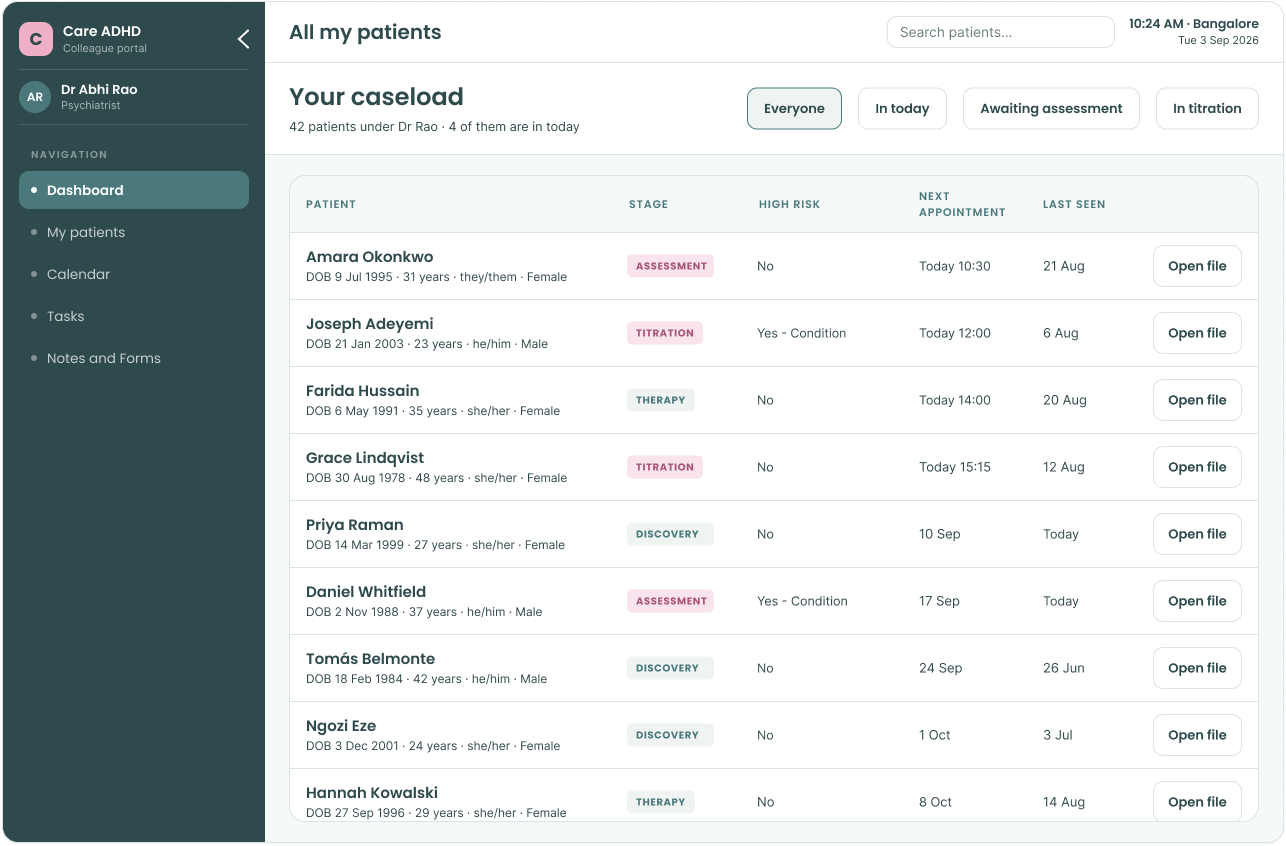
  • Pre-assessment and assessment tools for ADHD evaluation
  • Treatment planning and medication management
  • Step-by-step patient analysis and case notes
  • Patient appointment scheduling and calendar management
  • Notification management for patient status changes

Nurse Dashboard:

  • Vital measurements tracking (blood pressure, sugar levels, ADHD-related data)
  • Role-based access restrictions (only specific functions available)
  • Patient vital history and trends
  • Data entry for clinical observations

Receptionist Dashboard:

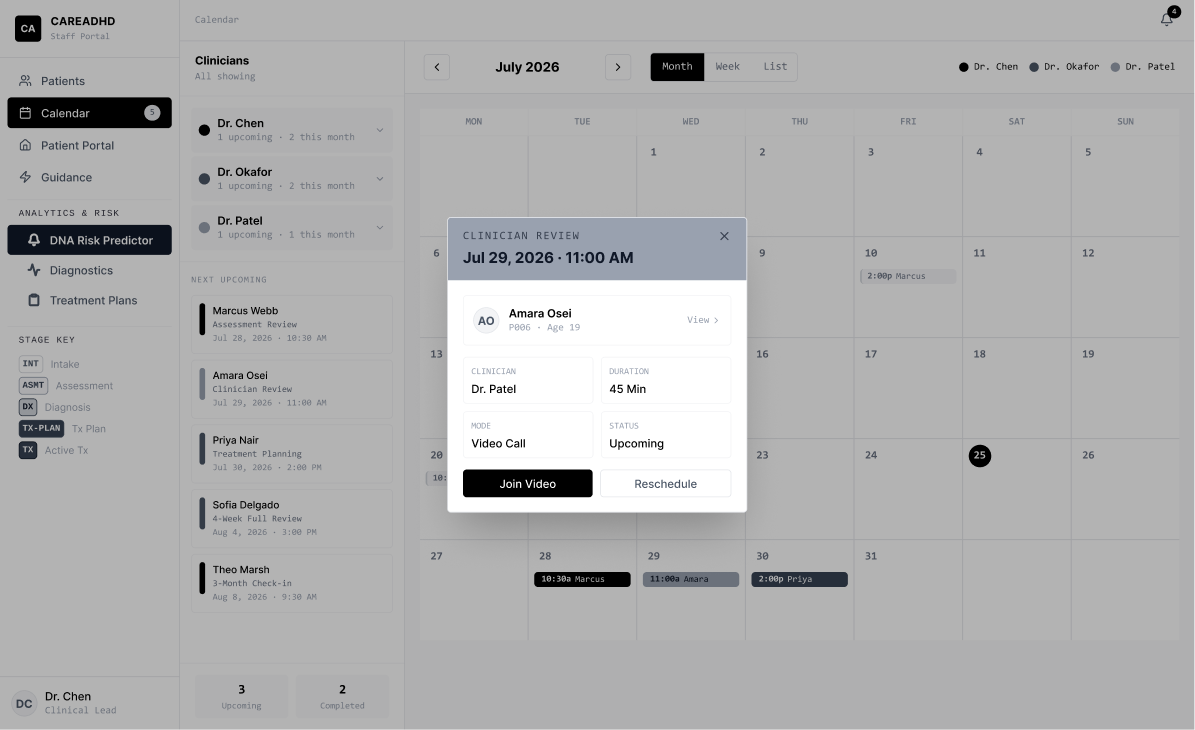
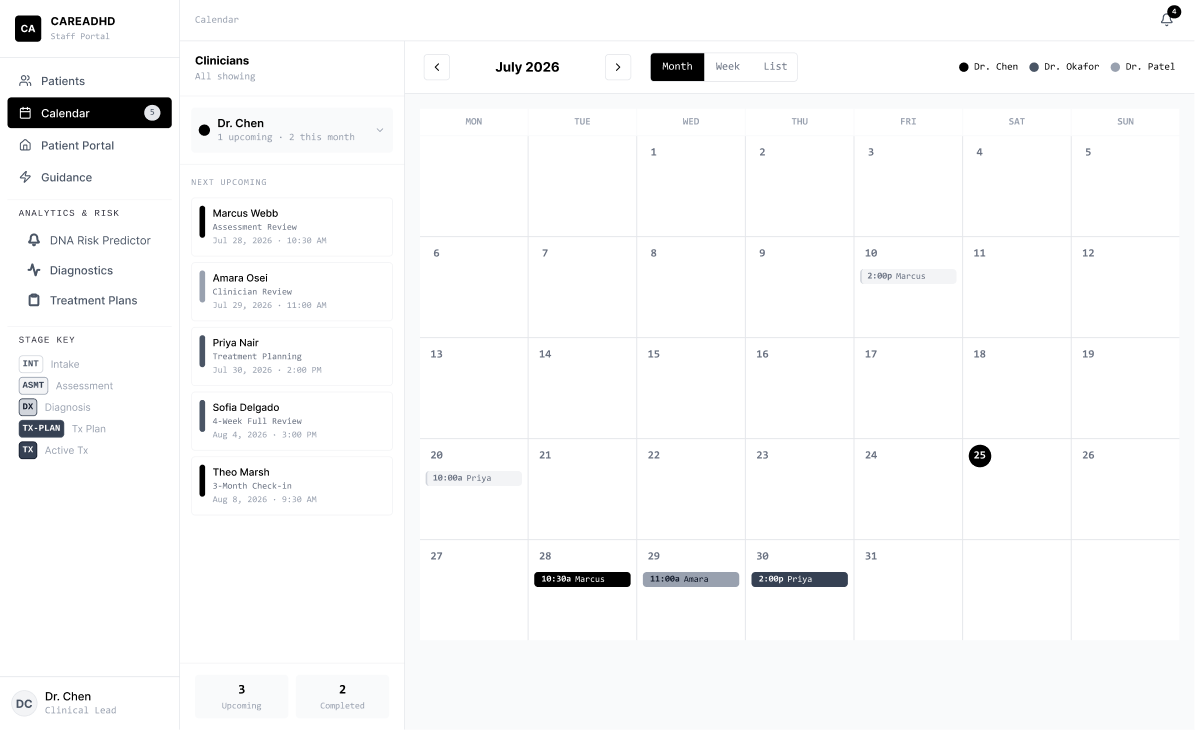
  • Master calendar management for all doctors
  • Manage all patient appointments across multiple clinicians
  • Patient appointment scheduling and rescheduling
  • Appointment confirmation and cancellation notifications
  • Calendar view for resource allocation

My Role & Responsibilities

I led the complete UX/UI design for Collect Portal, managing the full scope:

  • Research and discovery: Understanding ADHD patient management workflows in Indian healthcare context
  • User research: Defining needs for patients, clinicians, nurses, and receptionists
  • Information architecture: Designing role-based navigation and access patterns
  • Wireframes and flows: Creating detailed flows for appointment management, vital tracking, assessment tools
  • Visual design system: Developing color-coded theme system for each user role
  • Journey mapping: Documenting complete user journeys across all four roles
  • Interaction design: Designing role-specific interfaces with appropriate access restrictions
  • Timeline: 2.5 months of research, exploration, and iterative design refinement.
    The Problem

    ADHD patient management in Indian healthcare is fragmented across disconnected systems and roles. Each stakeholder works in isolation:

  • Patients: Struggle to track symptoms, understand risk levels, and manage appointments with multiple clinicians
  • Clinicians: Lack accessible patient history and step-by-step assessment tools, leading to repetitive evaluations
  • Nurses: Cannot easily input or access vital measurements or ADHD-related observations within clinic workflows
  • Receptionists: Manually manage calendars across multiple doctors, leading to scheduling conflicts and missed appointments
  • Care Coordination: No unified system to track risk levels, appointment status changes, or escalate urgent cases
  • Design Goal: Create an integrated platform where each role—patient, clinician, nurse, receptionist—has a tailored interface designed for their specific workflow. The system enables step-by-step ADHD analysis, risk assessment, vital tracking, and seamless appointment coordination across the entire care team.


    2.5-Month Research & Design Process

    Phase 1 - Discovery & Research (Weeks 1-3): Conducted user interviews and contextual inquiry with ADHD patients, clinicians, nurses, and clinic staff. Documented current workflows, pain points, and needs for each role. Created user personas for each stakeholder group.

    Phase 2 - Information Architecture (Weeks 4-5): Developed information architecture for role-based dashboards. Designed navigation hierarchies, access control models, and data flows specific to each user type. Explored how appointment management works differently for receptionists vs. patients.

    Phase 3 - Wireframing & Flows (Weeks 6-7): Created detailed wireframes for all four dashboards. Designed appointment scheduling flows, vital tracking interfaces, assessment tools for clinicians, and patient symptom tracking features. Iterated on role-specific workflows.

    Phase 4 - Visual Design & Theme System (Weeks 8-9): Developed color-coded theme system where each user role receives distinct visual treatment. Created a cohesive design system supporting multiple themes while maintaining brand consistency. Designed interactive components and states.

    Phase 5 - Journey Mapping & Documentation (Weeks 10): Documented complete end-to-end user journeys for each role. Created appointment flow from patient scheduling through receptionist confirmation to clinician notification. Documented edge cases and role handoffs.


    Role-Based Visual Design System

    Color-Coded Theme Approach: Rather than a one-size-fits-all interface, Collect Portal uses role-specific color themes that differentiate each user type visually:

  • Patient Dashboard: Warm, inviting colors (blues, greens) emphasizing personal health tracking and symptom awareness
  • Clinician Dashboard: Professional, clinical palette (deep blues, purples) supporting assessment and treatment planning workflows
  • Nurse Dashboard: Clear, functional design (teal, orange) optimized for vital measurement entry and data accuracy
  • Receptionist Dashboard: Organized, calendar-focused theme (grays, accent colors) for appointment management and scheduling
  • Design System Consistency: Despite different themes, all dashboards share consistent component library, typography hierarchy, spacing, and interaction patterns. This maintains usability while providing visual role differentiation.

    Accessibility Considerations: Color is never the only differentiator—roles are also identified by layout, iconography, and labels, ensuring the interface remains accessible for color-blind users.


    Final Design Scope & Deliverables

    Designed & Delivered:

  • Patient Dashboard: Symptom tracking, risk level display, appointment management, medication reminders
  • Clinician Dashboard: Assessment tools, treatment planning, patient case notes, appointment calendar
  • Nurse Dashboard: Vital measurements entry, ADHD-related data tracking, patient history access
  • Receptionist Dashboard: Multi-doctor calendar management, appointment scheduling, patient queue management
  • Role-Based Access Control System: Ensuring each user role sees only authorized data
  • Color-Coded Theme System: Distinct visual treatments for each role while maintaining design consistency
  • Complete User Flows: From appointment scheduling through treatment planning and vital tracking
  • Journey Maps: End-to-end documentation of each stakeholder’s workflow and interaction points
  • Design System Components: Reusable elements supporting all four dashboards
  • Key Interaction Patterns:

  • Appointment workflow from patient request → receptionist confirmation → clinician notification → patient reminder
  • Risk assessment progression: Low → Medium → High with corresponding notification levels
  • Vital measurement entry with validation and immediate clinician notification for abnormal readings
  • Role-based information visibility (nurse sees vitals, clinician sees vitals + assessment notes, patient sees only their own data + risk level)
  • Key Design Insights & Learnings

    Multi-Role Design Complexity: Designing one dashboard is hard; designing four interrelated dashboards for different user types is exponentially harder. Appointment scheduling from a patient's perspective is completely different from a receptionist's calendar view—same data, completely different UI needs.

    Role-Based Access Control is Critical: Healthcare data sensitivity means every field must be protected. A nurse shouldn't see clinician notes. A patient shouldn't see staff conversations. The access control model drives the entire information architecture.

    ADHD-Specific Design Considerations: ADHD patients may struggle with complex appointment management or detailed form filling. Designs needed to balance comprehensive clinical assessment with simplicity for patients managing attention difficulties.

    Indian Healthcare Context: Designing for Indian healthcare means accounting for varied digital literacy, preference for clear hierarchies, and workflows that differ from Western healthcare models. The receptionist role is particularly important in Indian clinics—they're the hub that keeps everything coordinated.

    Color Coding Works for Role Differentiation: Using distinct color themes for each role helps users immediately understand which interface they're in. A nurse seeing green/teal knows they're in the vital-tracking interface, while a doctor in blue knows they're in clinical mode.

    Documentation Matters as Much as Screens: The user flows and journey maps are not just deliverables—they're the roadmap for implementation. They show developers what happens when a receptionist cancels an appointment (does the patient get notified? Does the doctor see it?). This level of clarity is essential.


    Future Development Priorities

    Validation & Testing Needed:

  • Usability Testing with Real Users: Test all four dashboards with actual patients, clinicians, nurses, and receptionists. Validate that role-specific UIs actually match their workflows.
  • ADHD Clinical Consultation: Validate assessment tools and risk assessment criteria with ADHD specialists. Ensure the step-by-step analysis aligns with clinical standards.
  • Indian Healthcare Audit: Test with clinics and hospitals in India to ensure workflows match real operating procedures (appointment booking, vital recording, patient queuing).
  • Data Privacy Audit: Ensure all four dashboards properly enforce access control. No role-based leakage.
  • Phase 2 Design Work (Not Yet Started):

  • User authentication and account management flows
  • Patient onboarding and clinic registration
  • Doctor profile setup and clinic configuration
  • Notification preferences and reminder settings for each role
  • Report generation and data export for clinicians
  • Analytics dashboard for clinic administrators
  • Mobile responsiveness refinement for nurse vital entry
  • Success Metrics to Track:

  • Appointment booking time (receptionist dashboard efficiency)
  • Vital entry speed and accuracy (nurse dashboard effectiveness)
  • Patient symptom tracking compliance (patient dashboard engagement)
  • Clinician assessment completion rate (clinician dashboard usability)
  • User satisfaction by role
  • Progressive disclosure of advanced settings (most families want simplicity, some want granular control)
  • Success Metrics to Establish:

  • Family adoption rate (% of elderly users with at least one family member connected)
  • Alert accuracy (false positive rate of health anomaly detection)
  • Response time (how quickly family responds to genuine health alerts)
  • Trust & willingness to use (elderly users' confidence in privacy and system fairness)